
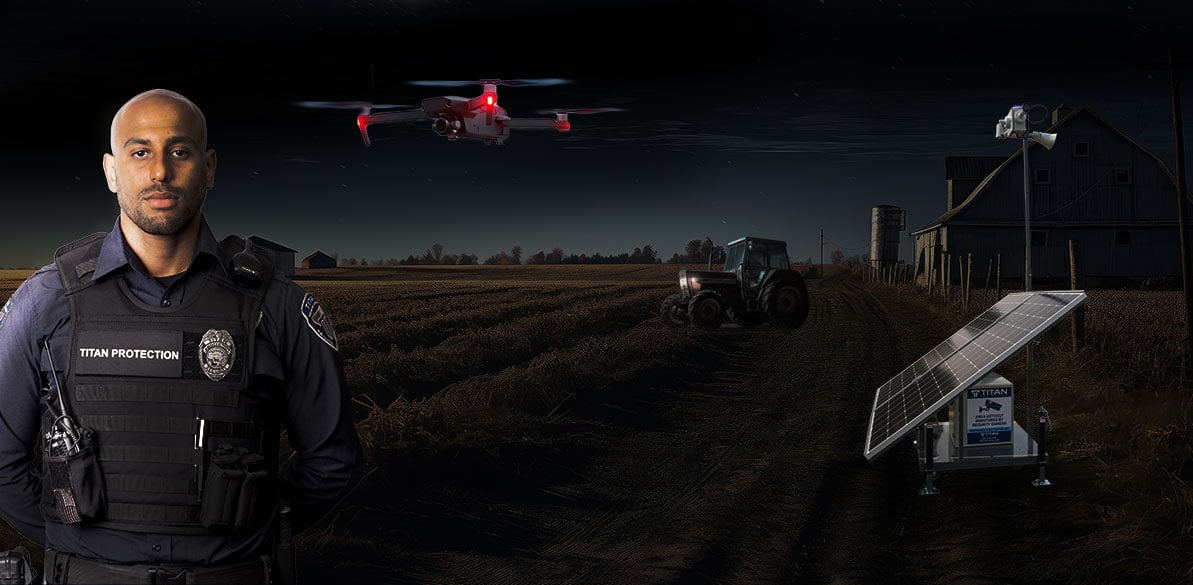
Nighttime Farm Security with Monitoring & Drone Response
- Video Monitoring,
- Drone Security,
- Blended Security,
- Farm Protection
Continuous Monitoring is becoming essential for modern farms facing growing risks like equipment theft, trespassing, vandalism, and operational disruptions across large rural properties.
Traditional security methods often leave blind spots and delay response times, especially after hours when farms are most vulnerable. By combining real-time video surveillance, intelligent analytics, and rapid response capabilities, continuous monitoring helps agricultural operations maintain visibility, protect valuable assets, and reduce costly downtime before incidents escalate.
Farm operations may slow down at night, but exposure doesn’t:
- Equipment remains in the field.
- Access roads stay open.
- Perimeters stretch across large areas that can’t always be seen or reached quickly after dark.
When visibility drops, farms become more vulnerable to theft, trespassing, vandalism, and unauthorized activity.
Most operations already have a range of security tools, such as cameras and sensors, but that control over the environment often disappears once the workday ends.
When no one is actively watching, verifying alerts, or responding in real time, farms lose the ability to understand what’s happening across the property as it unfolds. And once that control breaks down, incidents have more time to escalate.
Protecting farms after dark requires more than presence. It requires systems that maintain visibility, awareness, and response throughout the night.
What “Control Loss” Looks Like on Farms at Night
Large farms operate differently after hours, when staffing decreases and activity slows. Buildings and equipment spread across long distances create an environment where problems can develop unnoticed for extended periods of time.
Control loss happens when:
- No one is actively monitoring activity
- Alerts are delayed, missed, or ignored
- Response takes too long to reach the scene
- Operators can’t determine whether an event is real
Under those conditions, farms shift into a reactive posture. Instead of stopping incidents as they happen, they discover them later—after equipment is damaged, gates are breached, or inventory is missing.
Why Passive Security Systems Fall Short After Dark
Many traditional farm security systems are passive by design. They record activity, generate alerts, and store footage…but they don’t actively intervene.
A camera that records an intrusion overnight may provide evidence the next morning, but it doesn’t stop the intrusion from happening. Motion alerts without verification often create constant noise, leading operators or staff to ignore notifications altogether.
Over time, passive systems create a false sense of security: coverage exists but without oversight. That gap becomes more dangerous at night, when fewer people are present and response times are naturally longer.
The Shift From Passive Security to Active Oversight
Strong nighttime farm security depends on maintaining operational control after dark.
That requires a system built around three capabilities:
- Continuous monitoring
- Real-time verification
- Immediate response
Together, these elements create active oversight that goes beyond simply collecting information to continuously:
- Observe activity
- Determine whether it matters
- Responds before situations escalate
The goal is not just surveillance, but maintaining control across the property throughout the night.
Continuous Monitoring Maintains Visibility Across the Property
With video monitoring services, farms gain uninterrupted visibility into key areas after hours with monitoring systems actively watching:
- Entry points
- Equipment yards
- Storage buildings
- Livestock zones
- Perimeter access roads
Rather than relying on occasional checks or next-day reviews, trained operators observe activity in real time, supported by AI-assisted detection systems. This creates constant awareness across areas that would otherwise go unwatched overnight.
When visibility remains uninterrupted, suspicious activity becomes much harder to hide.
Real-Time Verification Turns Alerts Into Action
Detection alone is not enough. Farms generate movement constantly; animals, weather conditions, vehicles, and environmental changes can all trigger alerts. Without verification, operators waste time responding to events that aren’t threats.
That’s where Virtual Security Guard plays a critical role by reviewing alerts to immediately and determine:
- Whether activity is legitimate
- Whether escalation is necessary
- What type of response is appropriate
This process filters out false alarms while accelerating response to real incidents. Most importantly, verification allows decisions to happen quickly and confidently instead of relying on guesswork.
Drone Response Extends Control Across Large Acreage
Large farm properties create a unique challenge: distance. Even when suspicious activity is identified quickly, physically reaching the area can take valuable time, especially at night.
Drone security helps close that gap with a response that provides:
- Immediate aerial deployment to intrusion points
- Visibility across remote or difficult-to-access areas
- Real-time situational awareness for responders
Instead of waiting for someone to drive across the property to investigate, drones verify activity within minutes and provide operators with a live understanding of what’s happening.
That rapid response capability often prevents situations from escalating further. Detection matters, but response is what prevents loss.
How the System Works Together
A single tool won’t provide comprehensive security. The strongest farm security systems don’t rely on integration.
A typical overnight workflow looks like this:
- Activity is detected near a perimeter or access point
- Monitoring operators review the event in real time
- A Virtual Security Officer verifies whether it is a legitimate threat
- A drone is deployed for immediate aerial assessment
- Appropriate response measures are initiated
At every stage, visibility and control are maintained. This is what separates active oversight from passive coverage.
Operational Impact for Enterprise Farms
When farms maintain control overnight, operations become more stable overall.
Managers gain:
- Better visibility into after-hours activity
- Faster response to potential threats
- Improved confidence across large properties
- Fewer disruptions caused by repeat incidents
Instead of reacting to losses the next morning, teams can address issues while they’re still manageable, a shift that improves both security and operational performance.
Financial Impact: Protecting Margins Through Prevention
Nighttime incidents carry real financial consequences.
Equipment theft, vandalism, and unauthorized access can lead to:
- Repair and replacement costs
- Operational downtime
- Insurance claims
- Increased liability exposure
Continuous monitoring and rapid response reduce those risks by limiting how far incidents escalate.
For enterprise farms, prevention protects more than assets—it protects operational continuity and long-term profitability.
Why Farms Choose Titan Protection
Titan Protection combines monitoring, verification, and drone response into one connected security system designed for large agricultural environments.
Rather than offering disconnected tools, Titan focuses on maintaining operational control across the property after dark, meaning:
- Real-time awareness
- Faster decision-making
- Immediate response capabilities
- Integrated oversight from detection through resolution
For farms managing large acreage and complex operations, that coordination makes a measurable difference.
Maintain Control with Continuous Monitoring
Farms don’t stop being vulnerable when the sun goes down. The operations that stay protected overnight are the ones that maintain visibility, verify activity quickly, and respond before situations escalate.
Titan Protection helps farms move beyond passive security and build systems that maintain control throughout the night.
Frequently Asked Questions about Continuous Monitoring on Farms
What causes farms to lose control at night?
Farms lose control when activity is not actively monitored, alerts go unverified, and response is delayed after hours.
How does continuous monitoring improve farm security?
Continuous monitoring provides uninterrupted visibility across the property, allowing suspicious activity to be detected and addressed immediately.
What role do drones play in farm security?
Drones provide rapid aerial visibility across large or remote areas, helping operators verify activity and respond faster.
Can farms maintain oversight without on-site staff?
Yes. Remote monitoring and Virtual Security Guard allow farms to maintain real-time oversight without requiring full overnight staffing.
What is the difference between passive and active security?
Passive security records events after they happen. Active security continuously monitors, verifies, and responds in real time.
Subscribe To Email Update
Posts by Topic
- Video Monitoring
- Drone Security
- Virtual Guard
- Construction Site Security
- Auto Dealership Security
- Blended Security
- News
- Press Release
- In The News
- Commercial Property Security
- Kansas City
- Parking Lot Security
- Events
- Farm Protection
- Farm Security
- St Louis
- St. Louis Security
- Cannabis Dispensary Security
- Critical Facility Security
- Hospital Security
- Insider
- Campus Security
- Data Center Security
- Solar Farm Security