24/7 Security for Kansas City Businesses
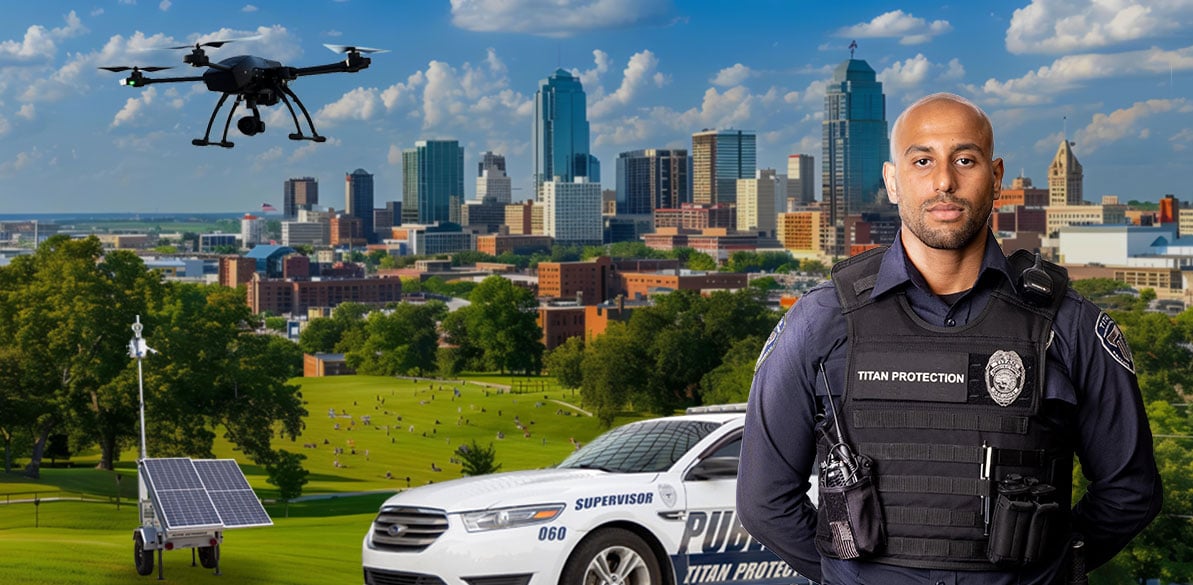
- Video Monitoring,
- Virtual Guard,
- Drone Security
Security needs rarely stay the same around the clock. Consider:
- A busy office building may need security officers managing access and interacting with employees and visitors during the workday, while activity drops significantly overnight.
- A corporate campus may have parking lots, wooded areas, or other sections that are difficult to cover with fixed cameras.
- An entertainment venue needs to protect its perimeter while creating a welcoming environment for thousands of guests.
Across Kansas City, maintaining 24/7 security increasingly means deciding which resources are best suited to each risk, location, and time of day.
Titan Protection has taken that approach with businesses throughout the Kansas City area, combining security officers, patrols, remote video monitoring, Virtual Security Guards, and drone security. Technology can extend visibility and handle routine monitoring, while trained security professionals provide the judgment and physical response needed when a situation requires human intervention.
That blended model is already changing how businesses think about 24/7 protection and offers a look at where physical security is headed.
24/7 Security Doesn't Always Require 24/7 Security Officers
Security officers remain an important part of many security programs. But keeping officers at every location around the clock may not be the most effective use of personnel or budget.
One Titan client, a large corporate campus in Overland Park, faced that question as its operations expanded. The property had grown to several hundred acres, and construction of a third office tower created additional areas that needed protection.
Rather than simply adding more officer hours, Titan developed a blended program. Security officers covered the campus during business hours, while remote monitoring and patrols helped provide protection after hours. During construction, a Virtual Security Guard monitored the site at night.
The result was 24/7 coverage with on-site guard spending reduced by as much as two-thirds. The client also reported no theft or vandalism during construction of the third tower.
That approach illustrates a basic principle behind modern security: resources can be deployed according to the job they perform best.
Security officers can focus on access control, employee and visitor interaction, incident response, and situations requiring a physical presence. Monitoring technology can provide continuous visibility into areas that don't require someone standing there throughout an entire shift.
Human Judgment Remains an Essential Part of Modern Security
Technology may be expanding what's possible, but effective security still depends on people who can interpret situations and make appropriate decisions.
The Kauffman Center for the Performing Arts provides a good Kansas City example. Located in the heart of downtown, the facility occupies a full city block and welcomes approximately 400,000 ticketed patrons. Its security team has to protect the property and its visitors without making a performing arts venue feel unwelcoming.
Titan has worked with the Kauffman Center for years, providing officers who have become part of the facility's day-to-day operations. As the Center's security needs evolved, technology became a larger part of the program as well. The facility approximately doubled its camera coverage after opening, with Titan personnel monitoring and operating those cameras.
The relationship between people and technology is important. A camera can show what's happening, but an experienced security professional can interpret the situation and decide how to respond.
The Kauffman Center shared one example involving a patron who arrived early for an event and appeared uncomfortable and agitated. Rather than treating the situation simply as a potential security threat, a Titan Officer recognized what was happening, approached the individual, and helped de-escalate the situation until the person's group leader arrived. The patron was ultimately able to stay and enjoy the performance. That's a responsibility technology alone can't fulfill.
Technology Can Extend the Reach of a Security Team
The value of technology becomes especially clear when properties are too large or complex to cover efficiently with personnel alone.
Remote video monitoring and Virtual Security Guards allow trained professionals to watch cameras, assess suspicious activity, and initiate an appropriate response. Depending on the situation, that might include an audio intervention, contacting someone on the property, dispatching a security officer or patrol, or notifying law enforcement.
That capability can also allow on-site officers to remain where they're most valuable rather than continually leaving their posts to investigate activity elsewhere.
Titan President and Founder Ryan Smith describes the company's approach as keeping the “human in the loop.” Technology handles much of the continuous monitoring and detection, while trained people evaluate events and determine what should happen next. Titan has built its security model around blending those two capabilities rather than treating people and technology as competing approaches.
That model is continuing to evolve as new security technologies become practical.
Drone Security Adds a New Dimension to 24/7 Protection
Drone security can extend visibility into areas that may be difficult, expensive, or unsafe to cover with fixed cameras or routine foot patrols.
A current Kansas City-area deployment demonstrates how that can work as part of a broader security program.
Shamrock Trading Corporation operates a campus of more than 70 acres, with security challenges that include parking lots, a lake, wooded sections, and areas where installing cameras or sending Security Officers can be difficult. Drone Security has added another layer to the company's existing security program.
The drone can patrol predetermined areas and provide aerial and thermal views of parts of the campus that previously presented coverage challenges. According to Titan's discussion with Shamrock, the deployment increased visual coverage by 60%.
The technology also allows the security team to investigate certain areas without unnecessarily sending personnel into potentially hazardous conditions.
Shamrock Director of Security Terry Owens described situations involving icy areas around the campus lake, difficult terrain, wooded areas, and a drainage area where physical access can be challenging. Drone coverage gives the team another way to determine what's happening before deciding whether someone needs to respond in person.
That doesn't eliminate the role of the security officer. It can make that role more focused.
Officers responsible for access control, for example, can remain at their posts while the drone provides visibility elsewhere on the property. When something requires further investigation or physical intervention, the security team has better information before personnel respond.
Different Layers Solve Different Security Problems
No single security measure can address every situation.
- Cameras provide persistent visibility but are limited by where they're installed.
- Security officers provide judgment, communication, and physical presence but can't be everywhere at once.
- Patrols can cover multiple areas but aren't continuously present at every location.
- Drone security can quickly reach large or difficult-to-access areas, but weather and other operational considerations can sometimes limit flights.
A modern security program can account for those strengths and limitations by creating layers of coverage.
Shamrock describes this philosophy as “security in depth”: if one resource is unavailable or isn't suited to a particular situation, another layer can provide coverage.
Titan applies the same basic principle across its security services. Depending on the property and risk profile, a program might combine:
- Security officers for access control, customer interaction, de-escalation, and physical response
- Patrol services for scheduled or randomized coverage across a property or group of locations
- Remote video monitoring and Virtual Security Guards for continuous visibility and intervention
- Drone security for aerial patrol, rapid investigation, and coverage of difficult-to-reach areas
- Human operators who evaluate activity and coordinate the appropriate response
The exact combination can vary because a corporate campus, retail property, construction site, entertainment venue, and industrial facility don't have identical security needs.
Kansas City Businesses Are Already Using the Future of Security
Some of the technologies changing physical security can sound futuristic. In practice, businesses are already using them.
Automated patrol routes, analytics, remote monitoring, thermal imaging, and drone security can give security teams visibility and information that weren't practical to obtain in the past. At the same time, people remain responsible for interpreting what that information means and determining what action should follow.
Smith has described the convergence of these capabilities as a shift from possibility to reality. After years of watching drone technology, remote operations, and physical security develop independently, he says the pieces needed to bring them together are now in place.
Owens sees similar potential from the customer side. As Shamrock has incorporated drone security into its existing layers of protection, his team has continued identifying new applications for the technology, from checking difficult areas of the campus to assessing conditions without unnecessarily sending personnel into them. He describes the technology's expanding role as something that “will be a game changer in the security industry.”
The future of security, then, doesn't have to mean replacing the resources businesses already rely on. It can mean giving security teams more ways to see what's happening, determine what requires attention, and put people where their skills provide the greatest value.
Build a Modern Security Strategy for Your Kansas City Property
Titan Protection is headquartered in Kansas City and works with businesses throughout the region to build security programs around their properties, operations, and risks.
From security officers and patrols to Virtual Security Guards, remote video monitoring, and drone security, Titan can combine multiple layers of protection into a 24/7 strategy designed around how your property actually operates.
Contact Titan Protection to discuss a modern approach to security for your Kansas City business.
Subscribe To Email Update
Posts by Topic
- Video Monitoring
- Drone Security
- Virtual Guard
- Construction Site Security
- Auto Dealership Security
- Blended Security
- News
- Press Release
- In The News
- Commercial Property Security
- Kansas City
- Parking Lot Security
- Events
- Farm Protection
- Farm Security
- St Louis
- St. Louis Security
- Cannabis Dispensary Security
- Critical Facility Security
- Hospital Security
- Insider
- Campus Security
- Data Center Security
- Solar Farm Security