Day and Night Drone Security: Maximize Coverage & Reduce Costs
- Drone Security
Security risks change throughout the day. A construction site may be busy with workers, contractors, and deliveries during business hours, then become largely vacant overnight. An auto dealership needs to protect employees, customers, and vehicles during the day, while unattended inventory becomes a greater concern after closing.
Traditional security programs often address these changing conditions by adjusting guard schedules, patrol routes, and monitoring coverage. But maintaining effective protection across large outdoor properties can become costly, particularly when valuable assets are spread across extensive areas.
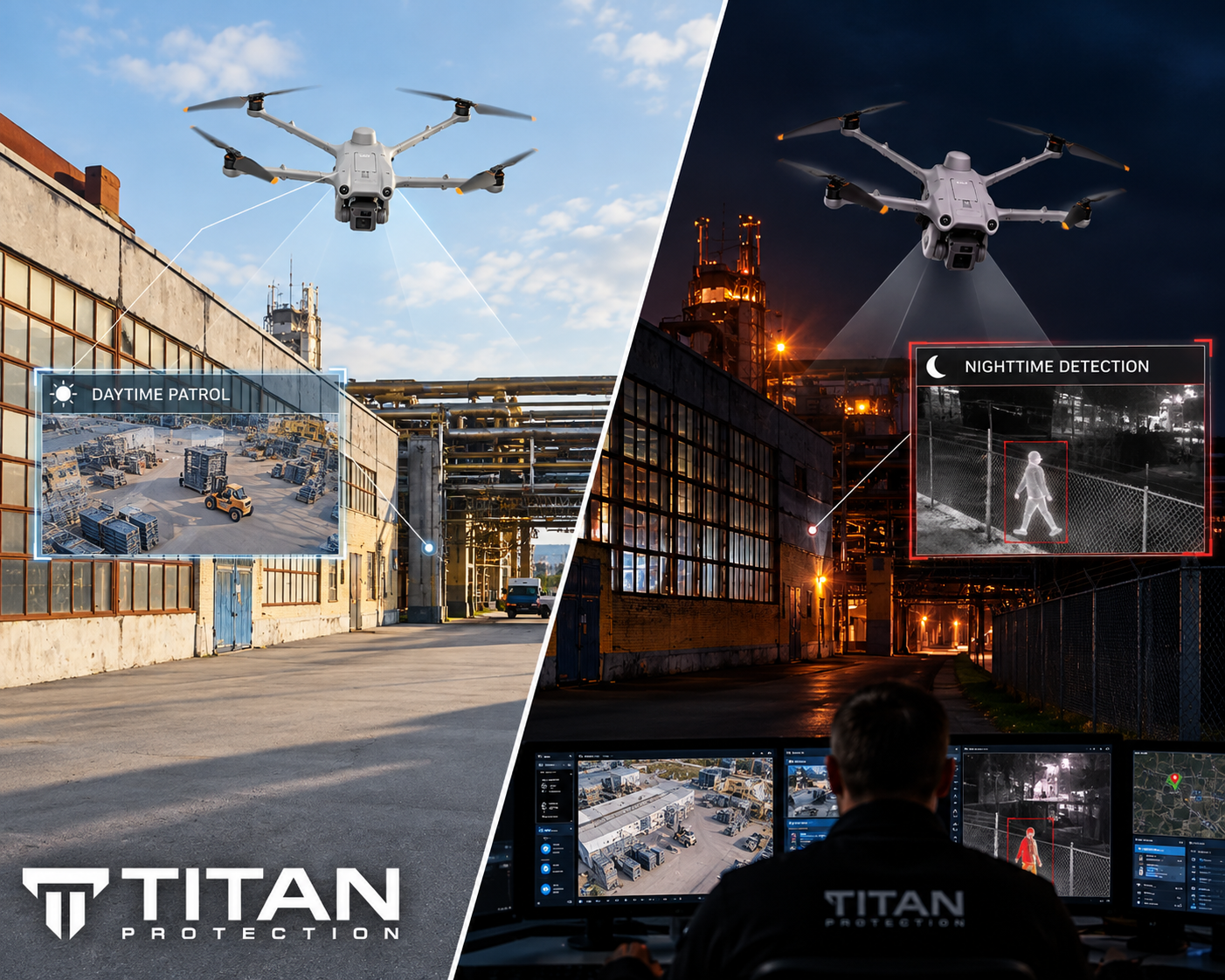
Drone security offers another way to provide coverage during the day and at night. With high-resolution cameras, thermal imaging, automated patrols, and live monitoring, the same system can support routine daytime operations and investigate suspicious activity after dark.
How Does Drone Security Work During the Day?
Daytime security presents challenges at large properties where employees, visitors, vehicles, and contractors are constantly moving.
At a distribution center, for example, security personnel may be responsible for monitoring truck entrances, loading areas, outdoor inventory, and perimeter access. Construction sites have changing work zones, equipment locations, and access points. Agricultural properties may have equipment, fuel, and other valuable assets distributed across hundreds of acres.
Drone security provides an aerial perspective that can help security teams assess these areas without requiring personnel to travel across the property for every inspection.
During daytime operations, drones can:
- Conduct scheduled patrols along perimeters and designated areas
- Investigate alarms or suspicious activity detected by cameras or sensors
- Check equipment yards, storage areas, and other locations that may be difficult to monitor from fixed positions
- Provide aerial visibility to officers and patrols responding to incidents
These capabilities are especially useful when officers are responsible for fixed posts or access-control duties. Instead of leaving a critical location to investigate an alert, personnel can use information from the drone to determine whether a physical response is necessary.
The result is greater visibility across the property and better use of existing security resources.
How Does Drone Security Protect Properties at Night?
After-hours security presents a different set of concerns. Fewer employees may be present, outdoor areas become less active, and valuable equipment or inventory can remain unattended for extended periods.
Reduced visibility also makes it harder to identify suspicious activity and determine what's happening beyond the reach of fixed cameras.
Modern security drones address these challenges with thermal imaging and cameras designed for low-light conditions. Thermal imaging can help operators detect heat signatures in darkness, while onboard cameras provide additional visual information when lighting conditions permit.
A drone can be dispatched to investigate an alarm, check a remote perimeter, or follow suspicious activity across an outdoor property.
These capabilities are particularly valuable for businesses with high-value assets outside their buildings. Auto dealerships, for example, face the risk of vehicle and parts theft after closing. Farms may have expensive machinery and equipment distributed across large, isolated areas. Construction sites can become targets for theft and vandalism once crews leave.
Titan explores these challenges in its articles on after-hours dealership lot security, continuous monitoring for farms, and construction site risk control.
How Can Day-and-Night Drone Security Improve ROI?
Using the same drone security infrastructure for both daytime and nighttime operations creates more opportunities to realize value from the investment.
The financial benefits generally fall into three areas.
1. Greater Value From the Same Infrastructure
A drone security program requires aircraft, docking and charging equipment, software, trained operators, and monitoring infrastructure.
Once that infrastructure is in place, it can support different security missions according to the property's operating schedule and risk profile.
A facility might use daytime patrols to monitor outdoor assets and investigate alerts, then adjust its patrol schedule overnight to focus on unattended equipment and remote perimeters.
This flexibility allows the same system to address a broader range of security needs without requiring separate daytime and nighttime surveillance programs.
2. Fewer Unnecessary Guard Hours
Maintaining physical security coverage across a large property can require substantial staffing, particularly when officers must travel between distant areas.
Drone security can help reduce that burden by handling certain patrol and investigation duties that would otherwise require personnel to leave their posts or travel across the site.
An officer may still be needed at an entrance, loading area, or other location requiring direct interaction. Meanwhile, drone patrols and remote monitoring can provide visibility across less active areas.
This blended approach can help businesses control security costs while keeping personnel focused on duties where their presence provides the greatest value.
3. Faster Investigation and Potentially Fewer Losses
When suspicious activity is detected, the time required to determine what's happening can influence the outcome.
A ground patrol may need several minutes to reach a distant location. Drone security can provide a faster aerial view, helping monitoring personnel assess the situation and direct responders to the appropriate area.
Faster investigation may also help prevent incidents from escalating into costly losses.
Titan demonstrated the potential financial impact in a Kansas City auto dealership deployment. Two dealerships shared a drone security system that helped stop an attempted theft of a $40,000 Corvette within five minutes. Titan reported a 50% reduction in security costs and a 400% first-year ROI for that deployment.
Those results are specific to the dealerships involved, but they illustrate how reduced security spending and prevented losses can contribute to the overall return.
Can Day-and-Night Coverage Double Your Drone Security ROI?
Using drone security during both daytime and nighttime operations can increase the value a business receives from the same infrastructure. However, doubling the hours or types of coverage doesn't automatically double financial ROI.
Actual returns depend on the property's size, existing security expenses, patrol requirements, potential losses, and the cost of the drone security service.
A facility with extensive overnight guard coverage may realize substantial labor savings by shifting appropriate duties to drones and remote monitoring. Another property may find greater value in faster incident verification or improved visibility across areas that previously received limited coverage.
The most useful comparison considers both the cost of maintaining the current security program and the additional capabilities drone security could provide.
Calculate Your Potential Drone Security Savings
Titan's drone security ROI calculator can help businesses estimate potential savings based on their current security expenses and coverage requirements.
The calculator provides an initial estimate. A site assessment can help determine how those assumptions apply to your property's actual security needs.
Titan Makes Day-and-Night Drone Security Easier to Manage
Getting value from drone security requires more than installing an aircraft and scheduling flights.
Commercial operations involve FAA requirements, licensed pilots, maintenance, monitoring, and procedures for responding to potential threats. Operating during daytime and nighttime hours also means accounting for different conditions and security priorities.
Titan Protection handles these responsibilities through its managed drone security service.
Titan's FAA-licensed remote pilots work with its 24/7 Security Operations Center to oversee patrols and incident response. Automated docking systems support launching, landing, and recharging, while monitoring personnel evaluate live video and coordinate with officers, patrols, or law enforcement when necessary.
The Security Operations Center provides around-the-clock monitoring and response coordination, although individual flights remain subject to battery life, weather, airspace requirements, and other operating conditions.
Businesses can also integrate drone security with existing cameras, monitoring systems, and on-site personnel rather than building a separate security operation.
Learn more in "The Drone Is the Easy Part: How Titan Takes on the Operational Burden of Drone Security."
Get More Value From Drone Security, Day and Night
A property's security requirements change throughout the day. Daytime activity creates one set of monitoring and response needs, while nighttime conditions introduce others.
Drone security can support both through scheduled patrols, rapid investigation, aerial visibility, and integration with existing security resources. That flexibility gives businesses additional ways to protect outdoor assets, make better use of personnel, and control security costs.
Titan Protection develops drone security programs around each property's layout, operating schedule, and risks, combining aerial technology with experienced monitoring and response personnel.
See how drone security can support your property during the day, at night, and everywhere in between. Explore titan's drone security solutions.
Subscribe To Email Update
Posts by Topic
- Video Monitoring
- Drone Security
- Virtual Guard
- Construction Site Security
- Auto Dealership Security
- Blended Security
- News
- Press Release
- In The News
- Commercial Property Security
- Kansas City
- Parking Lot Security
- Events
- Farm Protection
- Farm Security
- St Louis
- St. Louis Security
- Cannabis Dispensary Security
- Critical Facility Security
- Hospital Security
- Insider
- Campus Security
- Data Center Security
- Solar Farm Security