As St. Louis Industrial Properties Grow, Security Has to Keep Up
- Video Monitoring,
- Construction Site Security,
- Virtual Guard
St. Louis has long been well positioned for industrial and logistics operations. The region's network of interstate highways, rail lines, airports, and waterways connects manufacturers and distributors with markets throughout the country. That infrastructure continues to attract investment in warehouses, distribution centers, manufacturing facilities, and other large commercial properties.
Recent development activity reflects that demand. According to Colliers' Q2 2026 St. Louis industrial market report, 3.6 million square feet of build-to-suit industrial space is under construction across the region. Amazon, Boeing, Pepsi, Eaton, Whirlpool, Cummins, and LKQ are among the companies expanding their local footprints.
CBRE also sees continued momentum ahead, with data center investment and returning demand from large industrial users contributing to a new construction cycle in established St. Louis submarkets.
As industrial properties expand and new facilities come online, security teams have more ground, assets, and activity to protect. Large perimeters, loading areas, parking lots, equipment, inventory, and around-the-clock operations can make these properties particularly challenging to secure.
Addressing those risks calls for a security plan designed around the way each property actually operates.
Why St. Louis Remains an Important Industrial and Logistics Market
Location is one of St. Louis' longstanding advantages.
The Missouri Department of Transportation identifies transportation and distribution and advanced manufacturing among the region's leading industries. Major highways include I-44, I-55, I-64, I-70, I-255, and I-270, while the region also has extensive rail, air, and river connections.
That transportation network helps explain why industrial demand continues to concentrate along major logistics corridors.
Colliers reported 1.8 million square feet of industrial leasing activity during Q2 2026. Although the overall market is normalizing from the unusually strong conditions of recent years, the firm found continued demand for well-located industrial space and ongoing investment in build-to-suit facilities.
The facilities being built and occupied across the region can also present security challenges very different from those of an office building, retail location, or smaller commercial property.
Large Industrial Properties Create Large Security Footprints
A warehouse or manufacturing facility may cover hundreds of thousands of square feet, with additional property extending well beyond the building itself.
Parking lots, loading docks, storage areas, employee entrances, truck gates, equipment yards, and perimeter fencing can all require attention. Some facilities also operate around the clock, creating a steady flow of employees, contractors, drivers, and deliveries.
The result is a large and constantly changing security environment.
Fixed cameras may provide good visibility in some areas while leaving blind spots elsewhere. An officer stationed at an entrance can manage access and respond to activity nearby but can't simultaneously monitor every corner of a large property. A patrol can cover more ground, but it only has visibility into a particular location while passing through it.
Effective industrial security starts by identifying those different needs rather than applying the same type of coverage across the entire property.
Protecting Outdoor Assets and Perimeters
Much of the risk at an industrial or logistics property can exist outside the building.
Trailers, vehicles, equipment, raw materials, finished products, and other assets may remain outdoors overnight. Loading areas can stay active long after normal business hours, and large perimeters can include sections that receive little routine foot traffic.
These conditions can create opportunities for theft, vandalism, trespassing, and unauthorized access.
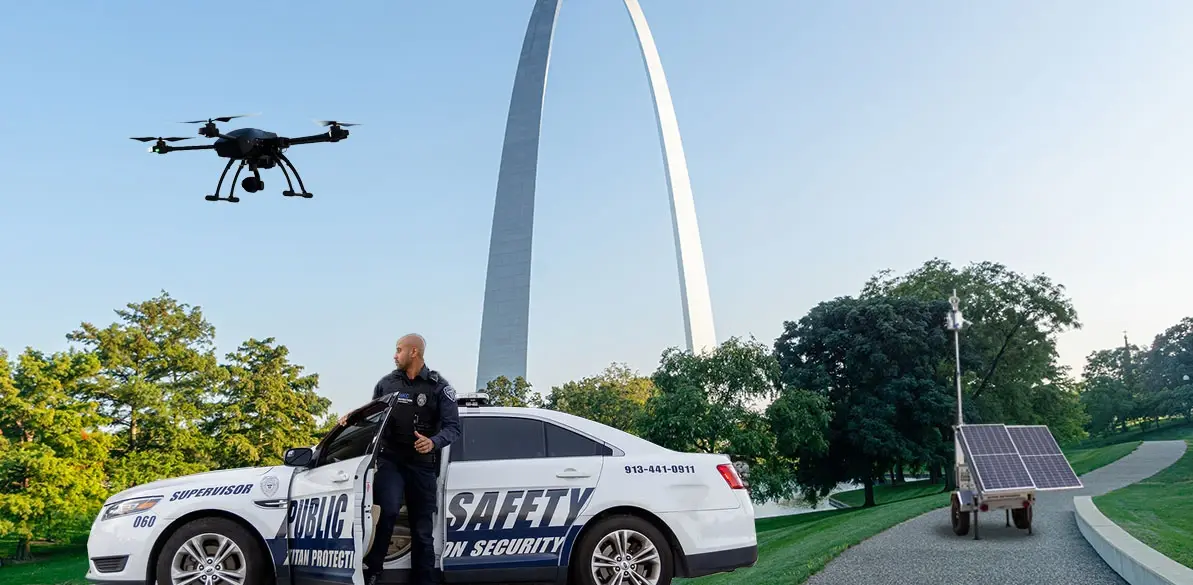
Perimeter security therefore has to provide both visibility and a way to act when suspicious activity is detected. Depending on the property, that may involve cameras and live monitoring at vulnerable locations, scheduled or randomized patrols, officers at access points, and drone security for large outdoor areas.
The right combination depends on where assets are located, when activity occurs, and how quickly the security team needs to respond.
Loading Areas and Access Points Require a Different Kind of Coverage
A loading dock presents a different security challenge from a remote section of perimeter fencing.
Industrial facilities may have employees arriving for different shifts, trucks entering and leaving throughout the day, contractors performing work, and vendors making deliveries. Security teams need to distinguish normal business activity from activity that deserves further attention.
An officer can provide an important physical presence at high-traffic entrances and other locations where access needs to be managed. Officers can interact with employees, drivers, contractors, and visitors while responding to situations that require human judgment.
Other portions of the property may benefit more from continuous monitoring or periodic patrols.
Matching the resource to the location allows security personnel to remain focused on the areas where their presence provides the most value.
Live Monitoring Extends Visibility After Hours
Industrial facilities don't necessarily become inactive when a shift ends.
Inventory, equipment, vehicles, and materials remain on the property, and some locations continue operating throughout the night. Maintaining visibility across a large facility can become especially important during periods when fewer employees are present.
Titan's Virtual Security Guard provides live monitoring of camera-covered areas, allowing trained operators to identify suspicious activity and initiate an appropriate response.
That can include monitoring entrances, parking lots, loading areas, equipment yards, and other locations that need continued oversight. When operators identify activity requiring attention, they can follow established escalation procedures and coordinate a response.
Because the monitoring is active rather than limited to recorded footage, the security team has an opportunity to address an incident while it is occurring.
Patrols Provide a Physical Presence Across Larger Properties
Patrol services can add another layer of protection where a continuously staffed post isn't necessary.
Scheduled or randomized patrols can check gates, parking areas, loading docks, buildings, equipment yards, and other locations throughout a property. Varying patrol schedules can also make security activity less predictable.
For industrial and logistics facilities with multiple buildings or large outdoor areas, patrols provide a way to extend physical coverage without stationing an officer at every location.
They can also work alongside remote monitoring. When an operator identifies suspicious activity, a nearby patrol can be directed toward the area for further investigation when appropriate.
Drone Security Can Cover Areas That Are Difficult to Reach
Large industrial properties are particularly well suited to aerial visibility.
A drone can travel across extensive outdoor areas, investigate locations beyond the immediate view of fixed cameras, and provide security teams with another perspective on activity around the property.
Titan's drone security can conduct programmed patrols and investigate triggering events while being overseen by FAA-licensed remote pilots through Titan's 24/7 Security Operations Center.
That capability can be valuable around large perimeters, outdoor storage areas, equipment yards, parking facilities, and other locations where installing enough fixed cameras to eliminate every blind spot may be difficult.
Drone security can also complement resources already in place. Instead of requiring an officer to leave a post and travel across a large property simply to determine what's happening, aerial video can help the security team assess the situation and decide what response is appropriate.
Industrial Security Works Better as a Connected System
Officers, cameras, patrols, Virtual Security Guards, and drones each provide different capabilities. Their value increases when those resources are connected through a broader security strategy.
A camera may detect activity near an equipment yard. A Virtual Security Guard can assess what is happening. A drone may provide additional visibility across the surrounding property. If physical intervention is necessary, an officer or patrol can respond with better information about the situation.
This type of blended approach allows the security plan to account for different risks across the same property.
It also provides flexibility as conditions change. A newly constructed facility may initially need additional coverage around equipment, materials, and contractors. Once operations begin, the emphasis may shift toward access control, loading activity, employee parking, inventory, and after-hours monitoring.
Security resources can change along with the property.
Building Security Around the Property's Actual Risks
Industrial facilities may share common security concerns, but no two properties operate exactly alike.
A distribution center with constant truck traffic has different needs from a manufacturing facility with valuable outdoor equipment. A data center may place greater emphasis on perimeter protection and controlled access. A warehouse operating three shifts has a different activity pattern from a facility that becomes largely vacant overnight.
That makes the initial assessment important.
A security plan should consider the size and layout of the property, operating hours, access points, existing camera coverage, outdoor assets, employee and vehicle traffic, previous incidents, and areas where visibility or response may be limited.
From there, resources can be placed where they provide the greatest benefit rather than relying on a single solution everywhere.
Titan Protection Brings a Blended Approach to St. Louis Industrial Security
Titan Protection maintains a St. Louis office and provides security services throughout the metro area. Its approach combines trained personnel with technology based on the needs of the property.
That can include officers at locations where a physical presence is important, patrol services across larger properties, Virtual Security Guards for rapidly deployable surveillance, remote video monitoring for continuous visibility, and drone security to extend visibility across outdoor and difficult-to-cover areas.
These resources are supported by Titan's 24/7 Security Operations Center, where operators can monitor client camera systems and security drones in real time.
As St. Louis continues to invest in modern industrial, logistics, and manufacturing facilities, the properties themselves will continue to become larger and more complex. Security strategies need the flexibility to account for those environments.
The goal is to give security teams the right visibility, personnel, and response capabilities for the risks they actually face.
Protect Your St. Louis Industrial Property
Whether you're opening a new facility, expanding an existing operation, or reassessing security across a large industrial property, Titan can develop a security plan around your site's layout, operating schedule, assets, and risks.
Talk with Titan Protection about building the right mix of security for your St. Louis property.
Subscribe To Email Update
Posts by Topic
- Video Monitoring
- Drone Security
- Virtual Guard
- Construction Site Security
- Auto Dealership Security
- Blended Security
- News
- Press Release
- In The News
- Commercial Property Security
- Kansas City
- Parking Lot Security
- Events
- Farm Protection
- Farm Security
- St Louis
- St. Louis Security
- Cannabis Dispensary Security
- Critical Facility Security
- Hospital Security
- Insider
- Campus Security
- Data Center Security
- Solar Farm Security