Reducing Farm Security Costs With Blended Security
- Video Monitoring,
- Virtual Guard,
- Drone Security,
- Farm Security
Every farm owner wants to protect equipment, buildings, livestock, and inventory without letting security costs grow faster than the operation itself..
That balance becomes harder to maintain as farms expand. More acreage creates more roads, more storage areas, and more places where equipment and materials are kept. Covering those areas with additional personnel isn't always practical, and rising labor costs only make the challenge greater.
The need for a farm security system is obvious, but the challenge is achieving better coverage without continually increasing staffing costs.
A blended security strategy offers one way to accomplish both.
Why Labor Costs Continue to Rise
Hiring security personnel involves more than hourly wages. Operations also absorb the costs of:
- Overtime
- Training
- Scheduling
- Employee turnover
- Supervisory oversight
- Shift coverage
Those expenses can add up quickly, particularly for farms that operate around the clock or span hundreds or even thousands of acres. Adding more people doesn't always translate into better visibility, especially when large portions of the property remain outside a patrol's immediate reach.
Large Properties Create Coverage Challenges
Agricultural operations rarely concentrate their assets in one location. Equipment yards, machine sheds, fuel storage, livestock facilities, grain bins, and remote fields may all sit considerable distances apart.
Even a dedicated security officer can only be in one place at a time.
As operations grow, maintaining consistent awareness across the entire property becomes increasingly difficult, particularly after normal working hours. The goal is to maintain consistent awareness across the property, regardless of how much ground needs to be covered.
A Smarter Approach to Farm Security
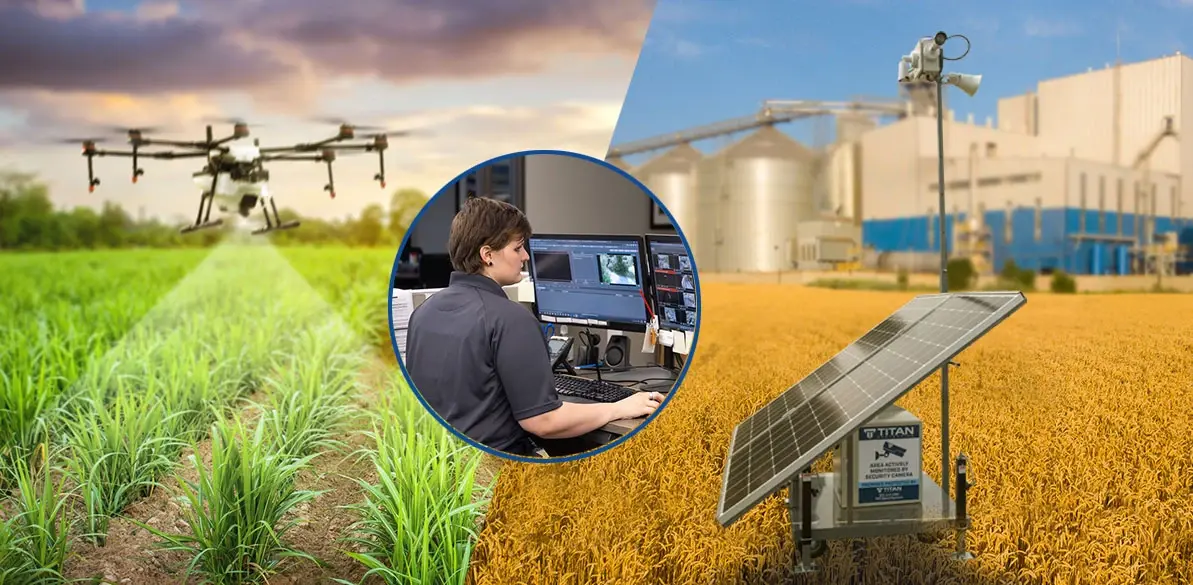
Many farms are moving toward security programs that combine technology with targeted response instead of relying primarily on continuous on-site staffing. A blended approach typically includes:
- Live video monitoring to maintain visibility
- Virtual Security Guards to verify suspicious activity
- Drone response to investigate large or remote areas when needed
Each component serves a distinct purpose, allowing resources to be used where they have the greatest impact. Rather than assigning personnel to watch areas where nothing is happening, operators focus attention on activity that requires investigation.
Continuous Monitoring Provides Full-Time Visibility
Modern video monitoring systems do more than capture footage. With video monitoring services, trained operators maintain real-time visibility across key areas of the property while intelligent analytics help identify unusual activity.
Monitoring can extend across:
- Equipment storage areas
- Perimeter access points
- Fuel tanks
- Livestock facilities
- Remote buildings
Because the system operates continuously, farms gain broader awareness without adding personnel to every location.
Virtual Security Guards Improve Efficiency
Not every alert requires someone to drive across the property. Virtual Security Guards review alerts as they occur, helping determine whether activity is routine or requires additional attention.
This process:
- Reduces unnecessary dispatches
- Improves response accuracy
- Allows one monitoring team to oversee multiple areas simultaneously
The result is consistent oversight that scales with the operation rather than with headcount.
Drone Response Supports Large Acreage
Some locations simply take time to reach. Drones provide large agricultural properties a practical way to investigate suspicious activity without sending personnel across miles of fields or access roads.
Drone security allows operators to:
- Inspect remote areas quickly
- Verify alarms
- Assess conditions from the air
- Support faster decision-making
Instead of maintaining constant patrols across the entire property, farms can direct resources where they are actually needed.
Measuring Security by Results
Traditional security programs often measure success by hours worked or the number of personnel assigned to a site. A blended security model shifts the focus toward outcomes.
Questions become:
- How quickly was suspicious activity detected?
- Was the alert verified?
- Was the appropriate response initiated?
- Were losses prevented?
Evaluating security this way helps farms align spending with measurable performance instead of staffing levels alone.
Long-Term Financial Benefits
Reducing labor costs is only part of the equation. A well-designed security program can also help lower expenses associated with:
- Equipment theft
- Property damage
- Emergency repairs
- Operational interruptions
- Insurance claims
At the same time, predictable monthly security costs make budgeting easier than managing fluctuating staffing needs and unexpected losses. Over the long term, those efficiencies can produce a stronger return on investment than relying exclusively on labor-intensive security models.
Better Visibility Supports Better Decisions
Continuous awareness provides operational benefits that extend beyond security. Farm owners and managers gain a clearer understanding of what's happening across the property, allowing them to respond more quickly when issues arise and allocate resources more effectively.
That visibility can reduce stress, improve planning, and help keep daily operations running smoothly.
Why Farms Choose Titan Protection
Titan Protection helps agricultural operations build security programs that match the realities of large, active properties.
By combining live monitoring, Virtual Security Guards, and drone response, Titan creates scalable solutions that improve visibility while helping control long-term security costs.
Rather than applying the same approach to every property, Titan works with farm owners to develop security strategies based on the size, layout, and operational needs of each site.
Build a More Efficient Farm Security Program
Managing security costs doesn't have to mean accepting less protection.
With the right combination of monitoring, virtual oversight, and targeted response, farms can improve visibility, reduce unnecessary labor expenses, and strengthen protection across the entire property.
Contact Titan Protection to schedule a farm security assessment and explore a security program designed to support both operational performance and long-term cost control.
Frequently Asked Questions about Reducing Farm Security Costs
How can farms reduce security labor costs?
Many farms lower costs by combining continuous monitoring, virtual security oversight, and targeted response rather than relying exclusively on full-time staffing.
Is monitoring more effective than hiring guards?
Monitoring provides continuous visibility across large areas, while on-site personnel remain valuable for situations that require a physical presence. Many farms benefit from using both together.
How do drones reduce farm security expenses?
Drones can quickly investigate remote areas, reducing the need for routine patrols across large properties and helping personnel respond more efficiently.
What is a Virtual Security Guard?
A Virtual Security Guard is a trained remote operator who monitors live video, verifies alerts, and coordinates the appropriate response when suspicious activity is detected.
Can large farms be secured without full-time security staff?
Depending on the property's layout and risk profile, many farms can achieve strong security coverage through a combination of monitoring, virtual oversight, and targeted response.
Subscribe To Email Update
Posts by Topic
- Video Monitoring
- Drone Security
- Virtual Guard
- Construction Site Security
- Auto Dealership Security
- Blended Security
- News
- Press Release
- In The News
- Commercial Property Security
- Kansas City
- Parking Lot Security
- Events
- Farm Protection
- Farm Security
- St Louis
- St. Louis Security
- Cannabis Dispensary Security
- Critical Facility Security
- Hospital Security
- Insider
- Campus Security
- Data Center Security
- Solar Farm Security